English

Views: 0 Author: Site Editor Publish Time: 2026-10-07 Origin: Site
Picture a heavy storm rolling in. The sky turns a bruised gray. You stare at the ceiling and wonder if your home will soon go dark. I hear this concern every week from homeowners evaluating renewable energy. Relying on daylight naturally breeds hesitation about system reliability during overcast weather or after sunset. True energy independence requires a consistent and predictable power supply.
Photovoltaic technology relies fundamentally on solar radiation. However, modern engineering has evolved to master these exact environmental variables. Today, we design sophisticated storage and conversion architectures to provide uninterrupted electricity twenty-four hours a day.
This guide resolves the uncertainty surrounding suboptimal weather conditions. We will dissect the mechanics of energy generation, analyze the empirical impact of cloud cover, and detail the specific hardware required to maintain continuous electricity access for your household.
Generation continues on cloudy days: Arrays produce 10% to 25% of their normal output depending on atmospheric density. They process ambient daylight rather than requiring direct rays.
Production ceases at night: Photovoltaic cells require photons to function. The physical process of energy creation pauses entirely after dusk.
Power remains accessible around the clock: Through utility net metering or dedicated on-site battery storage, your living space remains fully energized.
Hardware dictates reliability: Integrating specific components guarantees seamless energy management regardless of external weather patterns.
To grasp why weather and time of day affect performance, we must first look at the foundational physics of renewable generation. The entire process hinges on the photovoltaic effect.
When sunlight strikes a panel, it delivers microscopic particles of light known as photons. The internal cells—typically constructed from semiconducting materials like crystalline silicon—absorb these photons. This absorption knocks electrons loose from their atomic orbits. An electrical imbalance occurs. As these free electrons are forced to flow in a specific direction by the internal electric field of the cell, they generate direct current.
A crucial distinction is that these systems require light rather than heat to generate power. A widespread misconception assumes arrays perform best on the sweltering days of mid-summer. In reality, high ambient heat increases the electrical resistance within the silicon. This slightly degrades conversion efficiency. Consequently, a bright and crisp winter morning often yields exceptional energy production.
Prospective buyers constantly worry about regional climate patterns. The short answer is yes. They do function on cloudy days, albeit at a reduced capacity.
Clouds do not act as an impenetrable wall blocking all solar radiation. Thick cover obstructs direct sunlight. However, a significant volume of diffuse sunlight still penetrates the atmosphere. Modern panels are highly adept at capturing this scattered light to continue generating direct current electricity.
Specifically, output on heavily overcast days typically hovers between 10% and 25% of the maximum rated capacity. The exact yield depends heavily on the density and altitude of the cloud layers.
Furthermore, a fascinating phenomenon known as the edge-of-cloud effect can trigger temporary boosts in output. As the sun peeks through the fringes of passing cumulus clouds, the water vapor acts as a magnifying lens. This refracts the light and causes temporary spikes in solar irradiance. These spikes can actually exceed standard clear-sky conditions. Real-world adoption rates validate this capability. Regions famous for their perpetually overcast skies consistently rank among the top global producers of renewable energy.
Analyzing recent industry shifts regarding weather variability reveals a clear trend. The market is moving rapidly away from simple grid reliance toward holistic energy resilience. Historically, homeowners installed solar primarily for utility savings. Today, driven by increasingly erratic weather patterns, extreme storms, and grid instability, consumer focus has pivoted heavily toward autonomous power security.
Industry data highlights a massive surge in the adoption of hybrid configurations equipped with robust battery backups. Homeowners are no longer satisfied with panels that simply turn off when the grid goes down during a hurricane or winter freeze. Instead, the sector is standardizing microgrid setups capable of islanding themselves from the main utility. This evolution proves the industry has successfully transitioned from a sunny-day supplement to a robust round-the-clock utility replacement.
To directly address the core question regarding nighttime operation, the objective answer is a definitive no.
Because the photovoltaic effect relies entirely on the continuous absorption of photons, the absence of sunlight means the physical process of generating new electricity cannot occur. Once the sun dips below the horizon, the array enters a dormant standby state. It will not resume production until dawn breaks.
However, there is a critical distinction between generating power and having power. Just because the array stops producing electricity overnight does not mean your household goes dark. Modern setups are engineered with sophisticated energy banking mechanisms. These systems effortlessly bridge the gap between daytime production and nighttime consumption.
Since generation ceases at night and drops during severe storms, modern architectures utilize two primary pathways to keep your lights on and appliances running.
The most common approach in suburban environments is net metering. In this scenario, the municipal grid acts as a massive virtual battery. During peak sunlight hours, an array frequently generates more electricity than the property consumes. This surplus is exported to the local utility to earn energy credits. At night, the house automatically pulls electricity back from the grid utilizing those banked credits.
In contrast, the alternative involves on-site battery storage. For individuals seeking true energy independence, surplus daytime power is not exported. Instead, it is routed into a localized physical storage system. This allows the property to operate autonomously long after sunset.
For those looking to maximize their renewable investment and safeguard against outages, integrating a solar energy storage battery is a highly effective strategy.
This component functions exactly like a high-capacity power bank for your entire residence. Picture a busy summer afternoon. Your array is producing electricity at maximum capacity. The house consumes what it needs to run the air conditioning, while the surplus electricity is seamlessly directed into the battery bank. From an engineering standpoint, modern lithium iron phosphate units offer exceptional safety and longevity. For instance, a robust 24kWh battery storage setup can easily sustain a standard household through the night, keeping essential loads like refrigerators, well pumps, and lighting fully operational.
Once dusk arrives, the system automatically switches to discharging the stored reserves. The transition is instantaneous. It often occurs in milliseconds, ensuring the home remains powered by clean self-generated electricity. Beyond nighttime convenience, this hardware provides critical protection against rolling blackouts and allows homeowners to bypass exorbitant peak utility rates.
Understanding the architectural differences between setups is essential for determining how your property will handle nighttime energy management and severe weather events. To make the selection process transparent, I have broken down the three primary configurations.
System Type | Grid Connection | Nighttime Power Source | Blackout Protection | Best Application Scenario |
|---|---|---|---|---|
Grid-Tied | Fully connected | Utility Grid | None | Urban homes with stable grids and solid net metering policies. |
Off-Grid | Completely severed | Battery Bank | Complete | Remote cabins or farms with zero access to municipal power. |
Hybrid | Connected with backup | Battery + Grid | Complete | Suburban homes wanting grid benefits plus storm resilience. |
A standard grid-tied setup remains physically tethered to the municipal infrastructure. The utility grid serves as an infinite backup source. Conversely, an off-grid solar power system is entirely severed from the local utility network. Properties utilizing this independent architecture rely completely on the energy they produce and store on-site.
Because there is no municipal safety net to fall back on during prolonged stretches of heavy cloud cover, high-capacity battery banks are strictly mandatory. Designing this type of architecture requires precise load calculations to ensure the storage capacity can sustain the household through several consecutive days of low sunlight.
While panels harvest power and batteries store it, the entire ecosystem requires a central processing unit to manage the flow of electricity safely. Standard arrays produce direct current electricity, but household appliances operate on alternating current. The fundamental job of any inverter is to facilitate this conversion. However, modern energy management demands the intelligence of a hybrid solar inverter.
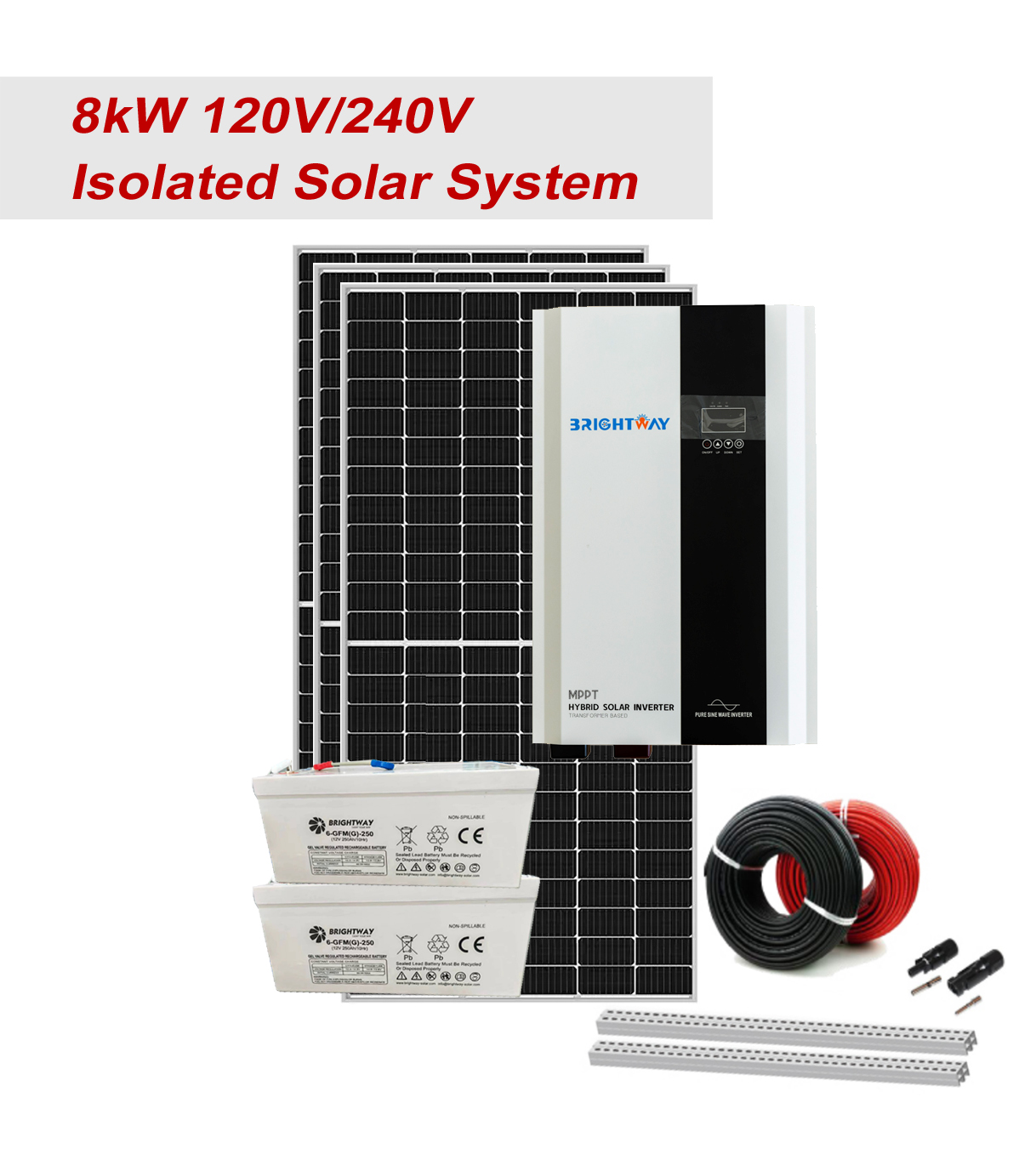
What makes this device exceptional is its ability to simultaneously orchestrate multiple power inputs and outputs. It acts as the intelligent brain of the setup. Take a standard 8kW hybrid inverter as an example. It coordinates the electricity flowing from the roof, manages the precise charge and discharge cycles of the storage bank, and controls the bidirectional flow of energy to the utility grid.
When a heavy storm cloud passes over and rooftop production plummets, this smart device instantly compensates by pulling the exact power deficit from the battery. When the sun sets, it seamlessly transitions the house to battery reserves. This switch happens so quickly that your digital clocks will not blink and your desktop computer will not shut down.
Translating these technical principles into a purchasing decision requires a practical approach. If you want to guarantee optimal performance during the shorter days of winter or power through nighttime outages, follow these specific selection standards.
First, calculate your critical nighttime load. Do not guess. Look at your utility bill and determine your average daily kilowatt-hour usage. A home consuming 30kWh daily will typically need a 10kWh to 15kWh battery to comfortably navigate the evening and night. For heavy usage or farm applications, upgrading to a 24kWh storage tier provides a comfortable safety buffer.
Second, over-size your panel array for cloudy climates. If you live in a region prone to overcast weather, install 20% more panel capacity than your baseline calculation dictates. Utilizing high-efficiency 500W solar panels ensures you maximize the limited roof space while capturing more diffuse light during gray afternoons.
Third, demand seamless switching. Ensure your inverter features a transfer time of less than 20 milliseconds. This guarantees sensitive electronics remain online when the system detaches from a failing grid during a storm.
Ultimately, photovoltaic technology operates strictly on the presence of daylight. While production ceases entirely during the night and drops significantly on cloudy days, these natural limitations do not equate to a loss of household power.
Through the strategic integration of modern storage solutions and intelligent conversion hardware, a well-designed setup effortlessly bridges the gap between active generation and continuous consumption. By banking excess daytime energy, homeowners can transform an intermittent power source into a reliable utility.
Are you ready to secure your household against unpredictable weather and rising utility costs? Stop leaving your energy security to chance. Visit Brightway Solar today to explore our professional-grade solutions. Whether you need a robust 8kW hybrid system for your suburban home or a high-capacity off-grid setup for remote farm use, our engineering team provides the exact hardware required to keep your lights on 24/7. Explore our product catalog and take the first step toward true energy independence.
Technically, moonlight is just reflected sunlight. This means the cells can pick up a microscopic amount of power during a bright full moon. However, the resulting output is so incredibly low that it is virtually zero. For all practical and functional purposes, photovoltaic systems do not generate usable electricity from moonlight.
Yes, they do. Rain actually provides a distinct maintenance benefit by naturally washing away accumulated dirt, dust, and pollen that block light absorption. While the heavy and dense clouds associated with rainstorms will reduce your overall energy production, the array will still generate power from the ambient diffuse daylight penetrating the storm clouds.
No, a battery is not strictly necessary unless you are building a completely independent off-grid architecture. If your home remains connected to the utility grid, you can utilize net metering to cover your nighttime energy needs. That said, adding a storage unit provides invaluable localized energy independence and crucial backup power during municipal grid outages.
Absolutely. Photovoltaic technology relies on light exposure rather than ambient heat. In fact, cold temperatures actually improve the electrical conductivity of the silicon cells. This makes them highly efficient on bright and crisp winter days. The primary winter maintenance concern is simply ensuring heavy snow is cleared from the glass surface so that sunlight can reach the cells.
Depending on the thickness of the cloud cover, solar panels typically produce between 10% and 25% of their maximum rated capacity on an overcast day. They achieve this by capturing diffuse sunlight scattered through the atmosphere. While output is lower than on a perfectly clear day, modern high-efficiency panels still harvest a meaningful amount of usable energy.
If you have a standard grid-tied system without a battery, your panels will automatically shut off during a blackout. This is a mandatory safety feature to prevent electricity from flowing back into the grid and injuring repair workers. To keep your house powered during an outage, you must install a hybrid inverter paired with a battery storage system.